
It is vitally important to protect your lungs and airways from harmful particles, such as asbestos and silica when working with hazardous substances. As such, fitted respiratory equipment must be correctly fitted to the face. In this article, we discuss whether or not men need to shave before a face fit test, as well as detailing the various other requirements of face fit testing.
Do you have to shave for a face fit test? In all cases you will be required to be clean shaven before a face fit test, and be shaven when wearing fitted RPE. Beards and stubble are not allowed as they prevent a good seal around the mask. However, some moustaches are allowed as long as all facial hair remains inside the mask, maintaining the seal.
Read on to learn more about the requirements of face fit testing, including which types of facial hair are and are not allowed.
Is it Mandatory to Shave Before a Face Fit Test?
When having a face fit test for fitted face masks and respirators, it is important that you achieve a good seal around the mouth and nose; facial hair can disrupt the seal, making it much easier for harmful particles to enter your airway. It is mostly required that those with facial hair shave before a face fit test.
Below you’ll find detailed information about the various types of facial hair that are and are not allowed when having face fit testing (and when wearing the fitted face mask).
Can You Have a Beard for a Face Fit Test?
Beards are not allowed for face fit tests, or afterwards when wearing the fitted mask. Masks need to create a good seal around the mouth and nose area in order to stop harmful particles from entering your airway. Facial hair that interferes with this seal (i.e. beards) make it impossible to achieve a good seal, and are therefore not allowed.
That being said, powered air hoods or helmets can be worn with a beard.
Can You Have Stubble for a Face Fit Test?
Following the same principles as beards, stubble does not allow for a good seal around the mask and, therefore, cannot be worn to a face fit test or afterwards when wearing the fitted mask.
Can You Have a Moustache for a Face Fit Test?
Some moustaches are allowed for face fit testing, however, not all are allowed, so it is best to check with your tester beforehand, or commit to shaving in order to create an assured seal.
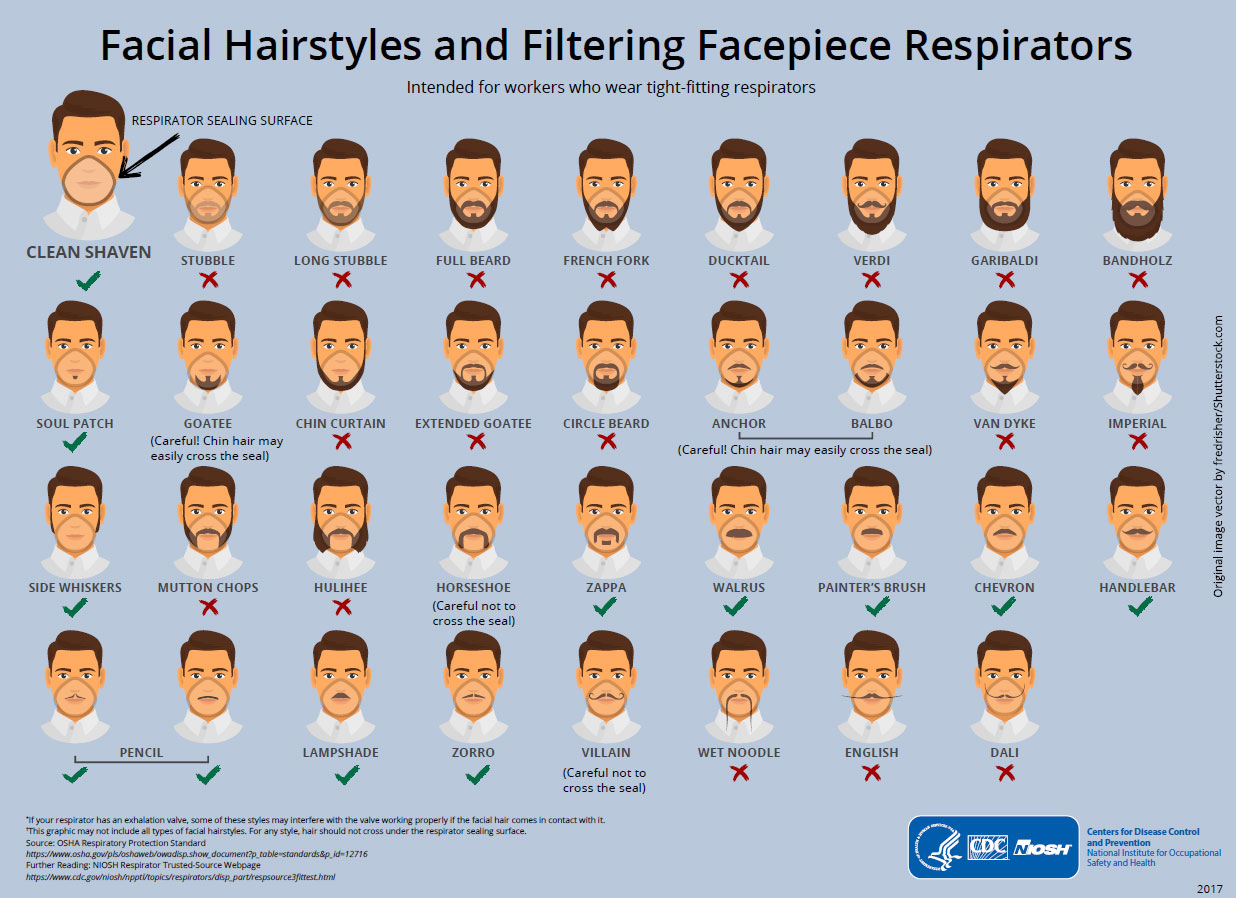
Generally, moustaches that sit completely within the mask area, and don’t obstruct the seal line are allowed, e.g. styles such as the Walrus, Painter’s Brush, Chevron, Handlebar, Pencil, Lampshade, and Zorro may be allowed provided that they are kept neat and tidy, and do not obstruct the mask seal.
[CDC Infographic Image- Can we upload this with credit or embed it?]
Are There Any Face Fit Test Requirements for Women?
Whilst women, typically, don’t have to contend with facial hair for face fit testing, there are still a couple of requirements that women must consider before having a face fit test. These rules also apply to men.
- Makeup cannot be worn during the face fit test, or afterwards whilst wearing the fitted mask as it can prevent a seal from being achieved
- Facial piercings around the nose and mouth area cannot be worn as these can prevent a good seal from being achieved
Other Face Fit Test Requirements
Other face fit testing requirements that must be followed include:
- Refrain from smoking for at least one hour prior to the test
- Do not consume hot or spicy food, or strong coffee two hours prior to test
- Glasses can cause issues when trying to achieve a good fit, therefore contact lenses should be worn where possible
- Make the tester aware of any relevant medical issues, such as Asthma, a cold, flu, or other conditions that may affect respiration
Exceptions to the Rules
As always, there are exceptions to the rules. For example, if facial hair is worn (and cannot be removed) for religious reasons, alternative RPE that does not rely on a tight face seal can be sourced.
If, for some legitimate reason, you cannot remove your facial hair for a face fit test, please speak with your tester beforehand to arrange a suitable alternative.
Which Masks Need a Face Fit Test?
In order to create a safe, tight seal that prevents harmful particles from entering your airway, face fit testing is required for all of the below mask types:
- Disposable half-masks
- Reusable, filter, or cartridge half-masks
- Powered respirators
- Full face filter or cartridge masks
- Escape set masks
- Full breathing apparatus masks
What Does a Face Fit Test Involve?
There are two types of face fit tests; one that can only be conducted on half-masks, and one that can be used for all types of masks.
Qualitative Face Fit Test
Qualitative face fit testing can only be used for half-masks. This test takes around 20 minutes, and you will be required to wear a hood over the head and shoulders. Your tester will then spray a bitter-tasting solution into the hood whilst you carry out a number of exercises. If you can taste the solution, the mask does not fit correctly.
Quantitative Face Fit Test
A quantitative face fit test can be used to fit any type of mask. The most common method for this test involves attaching the mask (whilst worn) to a machine which detects the number of airborne particles passing through the seal .This test takes approximately 2o minutes to complete and results in a ‘pass’ or ‘fail’.
How Often are Face Fit Tests Required?
Face fit tests should be carried out on a regular basis to ensure that a good, tight seal on the mask is maintained. This is left to each individual’s own judgement, but some companies have retesting policies of one, two, or three years, depending on risk levels. However, If any of the following apply to you, you will need to be retested regardless:
- Gain or lose weight
- Undergo significant dental work which changes your facial structure
- Develop facial changes (such as scarring or moles)
Why Wear Fitted Face Masks?
Fitted face masks help you to stay healthy on-site. Where respiratory equipment, such as masks, are used to protect the lungs from harmful particles, they need to be properly fitted to the face to ensure a tight seal. Without this, microscopic particles can enter the mask, and your airway.
Not wearing a well fitting mask can result in you becoming ill. This has obvious knock-on effects such as you missing work, affecting your family life and, in very severe cases, can result in death. HSE reports an estimated 24,000 deaths from 2009-2011 that were related to long-term exposure to respiratory hazards at work. A well fitting mask could have prevented this.
Face Fit Testing, Maintenance, and Servicing at Thermac
Thermac is a Fit2Fit accredited RPE Fit Test provider with years of experience fitting Disposable, Half face, Full face and Breathing Airline (BA) masks. Choose between a classic face fit test or face fit test training that allows you to competently conduct your own face fit testing for your team.
We also provide RPE maintenance and servicing to ensure that your equipment is safe to use, including mask integrity testing, mask maintenance training, and training for general use of RPE.
Learn more about our face fit testing services online, or get in touch with our team for more information.